       |
Life
1964- ; b. Cork, 23 Feb. of Irish and Turkish parentage; early years in Mozambique, Turkey and Iran but chiefly in the Netherlands from six; ed. Lycée français de La Haye and the British School in the Netherlands; grad. in Law from Girton Coll., (Cambridge); called to bar, 1987, and spent a year writing his first novel; practised as a barrister in a business law in London, 1990-98; m. Sally Singer, Vogue editor, with whom three sons; moved to New York, 1998, living at the Chelsea Hotel;
contrib. to The Atlantic Monthly; issued This Is the Life (1991) and The Breezes (1996); also Blood-Dark Track (2001), a family history recounting the imprisonment of two grandfathers, one Turkish and one Irish, in WWII, which Seamus Deane called ‘a remarkable work’ in The Irish Times; issued Netherland (2008), concerning a Dutchman whose friend at the Staten Island Cricket Club is murdered in the wake of 9/11; appeared on the cover of the NY Times (Sunday Book Review) and praised by the ‘the wittiest, angriest, most exacting and most desolate work of fiction’ about the event (Lit. Ed., Dwight Garner); missed Booker Shortlist but winner of PEN/Faulkner Award for Fiction and Kerry Group Irish Fiction Award, 2009; his story “The Referees” was shortlisted for the Sunday Times / EFG munificent short-story prize, Jan. 2015.
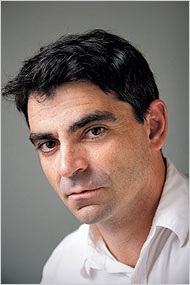
Photo: New York Times
[ top ]
Works| Fiction (novels) |
|
| Short fiction |
|
| Miscellaneous |
|
| Reviews |
|
| Antologised in |
|
[ top ]
Criticism| Studies |
|
| Reviews & interviews |
|
[ Note: There is an Irish Times interview-article c.2011 indicating that his family home was the Chelsea Hotel, New York. ]
[ top ]
Commentary
Stanley van der Ziel, ‘Beneath the Surface: The Subterranean Modernism of Joseph O’Neill’s Netherland, in Critique: Studies in Contemporary Fiction, 56, 2 (2015), pp.207-22 - summary: ‘Joseph O’Neill’s Netherland has often been read as an old-fashioned Realist novel happily oblivious to the technical innovations brought to bear on the novel in the twentieth century by Joyce, Proust, and Woolf and their postmodern followers. This essay argues that O’Neill is not unaware of the legacies of modernism and postmodernism, but that like many of his most distinguished contemporaries, he simply refuses, in Netherland and elsewhere, to write in a style that is outwardly or flamboyantly experimental. Because for all the apparent smoothness of the narrative surface of Netherland, O’Neill self-consciously engages throughout not only with the theoretical foundations of Realism itself but also with many of the key concerns of modernist and postmodernist literature.’ (Available at Taylor & Francis website as .pdf - via password; also available direct; accessed 17.03.2015.)
[ top ]
[ See opening from Netherland in “First Chapter” series of N Times (15 May 2008) - available online; see also copy as attached. ]
[ top ]
Notes
This Is the Life (1991): ‘A first novel from young Irish writer O’Neill, a barrister in London, whose hero is a sort of legal Lucky Jim at sea in the law. James Jones is one of those dreamy young men, secretly nurturing great ambitions but never quite able to pull them off, who lurks in every profession. An indifferent law student, Jones has been transformed by reading a book by famous international lawyer Michael Donovan. Thereafter, he reads everything Donovan writes and, after graduation, becomes Donovan’s “pupil” at his chambers. For six months, Jones works closely with his idol, a man obsessed by law and oblivious to everything else - but to Jones’s great disappointment, he is turned clown by the chambers at the end of his pupilage and has to join a small and undistinguished law firm. While he does unglamorous, nitty-gritty legal work, he embarks on a tepid relationship with Susan, as plain and undistinguished as himself, and tries to forget about the stimulating work he did with Donovan. But to Jones’s surprise, Donovan, rumored to have recently suffered a nervous breakdown, suddenly asks Jones to represent him in his divorce - a divorce Donovan does not want. Jones, who at last feels he’s getting closer to Donovan and fame, finds the man as elusive and puzzling as before. And given his penchant for getting things wrong, Jones not only fails to understand what is really going on but is nearly fired. His own subsequent breakdown leads him to admit that he’s been too much the dreamer: “No one was going anywhere. No one, not even Donovan, had anywhere to go.” Witty and perceptive - but too drawn out, too carefully crafted, and too repetitive to really stun. Promise, but without pizazz.’ (Kirkus Review; given in COPAC - online; accessed 07.01.2010.)
Netherland (2008): A Dutchman called Hans van den Broek, working as an equities analyst for a large merchant bank, lives in New York with his wife and son. Keen to fit in in his new land, he aims to get a driving licence and joins a cricket club on Staten Island. In the wake of 9/11 [terrorist attacks] they are forced uptown by the events in Manhatten, moving from their TriBeCa flat to the Chelsea Hotel where his marriage with British-born Rachel falls apart. He is trying to understand whether the situation is pre-apocalyptic or near-apocalyptic while is wife simply wants to return to England, far from George Bush. Then Chuck Ramkissoon, a West Indian and the one man with whom he forges a friendship in the Staten Island Cricket Club, is pulled out of a New York canal with his hands tied behind his back. (Source: Amazon.)
The Dog (2015) - publisher’s notice: ‘In this extraordinary, both comic and philosophically profound novel, the acclaimed author of Netherland uncovers the hidden contours of a glittering Middle Eastern city—and the quiet dilemmas of modernity. When our unnamed hero, a self-sabotaging and oddly existential lawyer, finds his life in New York falling apart, he seizes an opportunity to flee to Dubai, taking a mysterious job for a fabulously wealthy Lebanese family. As he struggles with his position as the“family officer” of the capricious Batros brothers, he also struggles with the“doghouse,” a condition of culpability in which he feels trapped, even as he composes endless electronic correspondence—both sent and unsent—in an attempt to find a way out. An unforgettable fable for our globalized times [...] told with Joseph O’Neill’s hallmark eloquence, empathy, and stylistic mastery.’ (Source: Amazon.)
Godwin (2024) - publisher's notice: ‘Mark Wolfe, a brilliant if self-thwarting technical writer, lives in Pittsburgh with his wife, Sushila, and their toddler daughter. His half-brother Geoff, born and raised in the United Kingdom, is a desperate young soccer agent. He pulls Mark across the ocean into a scheme to track down an elusive prospect known only as “Godwin”—an African teenager Geoff believes could be the next Lionel Messi. Narrated in turn by Mark and his work colleague Lakesha Williams, Godwin is a tale of family and migration as well as an international adventure story that implicates the brothers in the beauty and ugliness of soccer, the perils and promises of international business, and the dark history of transatlantic money-making.’ (Source: Amazon.)
Good Trouble (2019) - publisher’s note: ‘From the PEN/Faulkner Award–winning author of Netherland comes a collection of stunning, subversive, wryly comic stories that reveal the emotional depths and surprising beauty of life in the twenty-first century. A poet confronts the state of his art when asked to sign a petition-in-verse to free Edward Snowden. A man attending a wedding in Tuscany seeks a moment of solace with a friendly goose. A father uses a tracking app to follow his son’s stolen phone, opening wider questions of the world and its dangers. In these flashes of trouble, O’Neill unearths the real, secretly political consequences of our ordinary lives. No writer is more incisive about the world we live in now.’ (Source: Amazon.)
[ top ]